What Credit Card Rewards Really Cost: A Fee-vs-Value Study

Income Series may earn a commission from partners featured on this page; see our advertiser disclosure.
A credit card annual fee is a bet that the rewards will outrun the price tag. We priced that bet for 15 popular cards, from a $0 flat-rate card to the $895 Amex Platinum, using the same household spending on every card: $30,000 a year split the way the Bureau of Labor Statistics says Americans spend on groceries, dining, gas, hotels and flights.
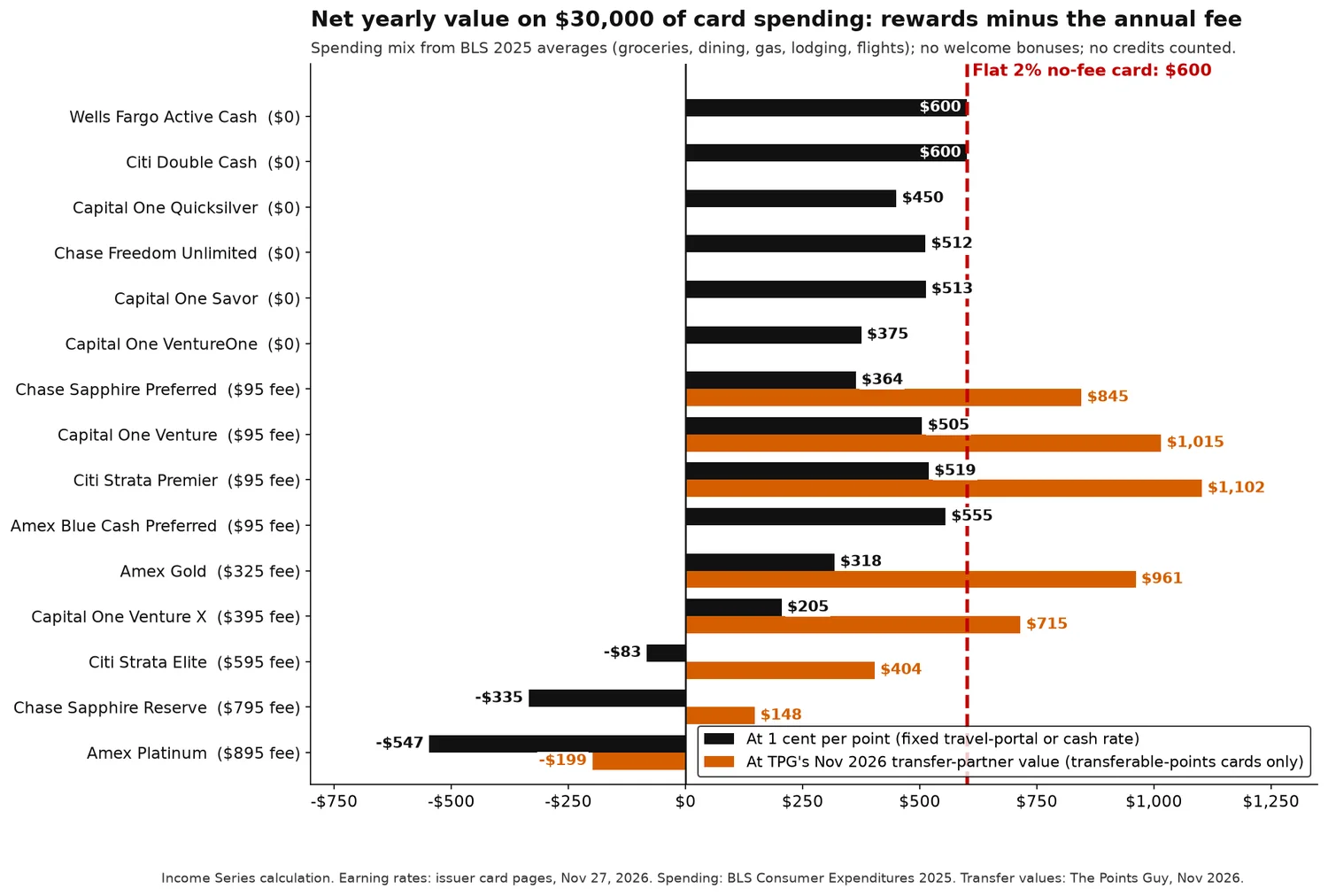
The short answer: a $0 card that pays 2% flat returns $600 on that spending. At a flat 1 cent per point, none of the other 13 cards beats it, and the Chase Sapphire Reserve and Amex Platinum lose money after their annual fees. Count points at what transfer partners can pay (The Points Guy’s, or TPG’s, November 2026 estimates of 1.85 to 2.05 cents) and five of the eight transferable-points cards pull ahead. The rest of this page shows every number and every step so you can rerun it with your own spending.
Five findings from the fee-vs-value study
- The 2% no-fee card is the bar. Wells Fargo Active Cash and Citi Double Cash each return $600 on $30,000. At 1 cent per point, the best fee card, the Amex Blue Cash Preferred, nets $555 after its $95 fee.
- Three of four premium cards earn less than $600 before the fee. On $30,000 at 1 cent, Amex Platinum earns $348, Sapphire Reserve $460 and Citi Strata Elite $512. Venture X ties the 2% card at $600. After fees, Platinum nets -$547, Reserve -$335 and Strata Elite -$83; Venture X nets $205.
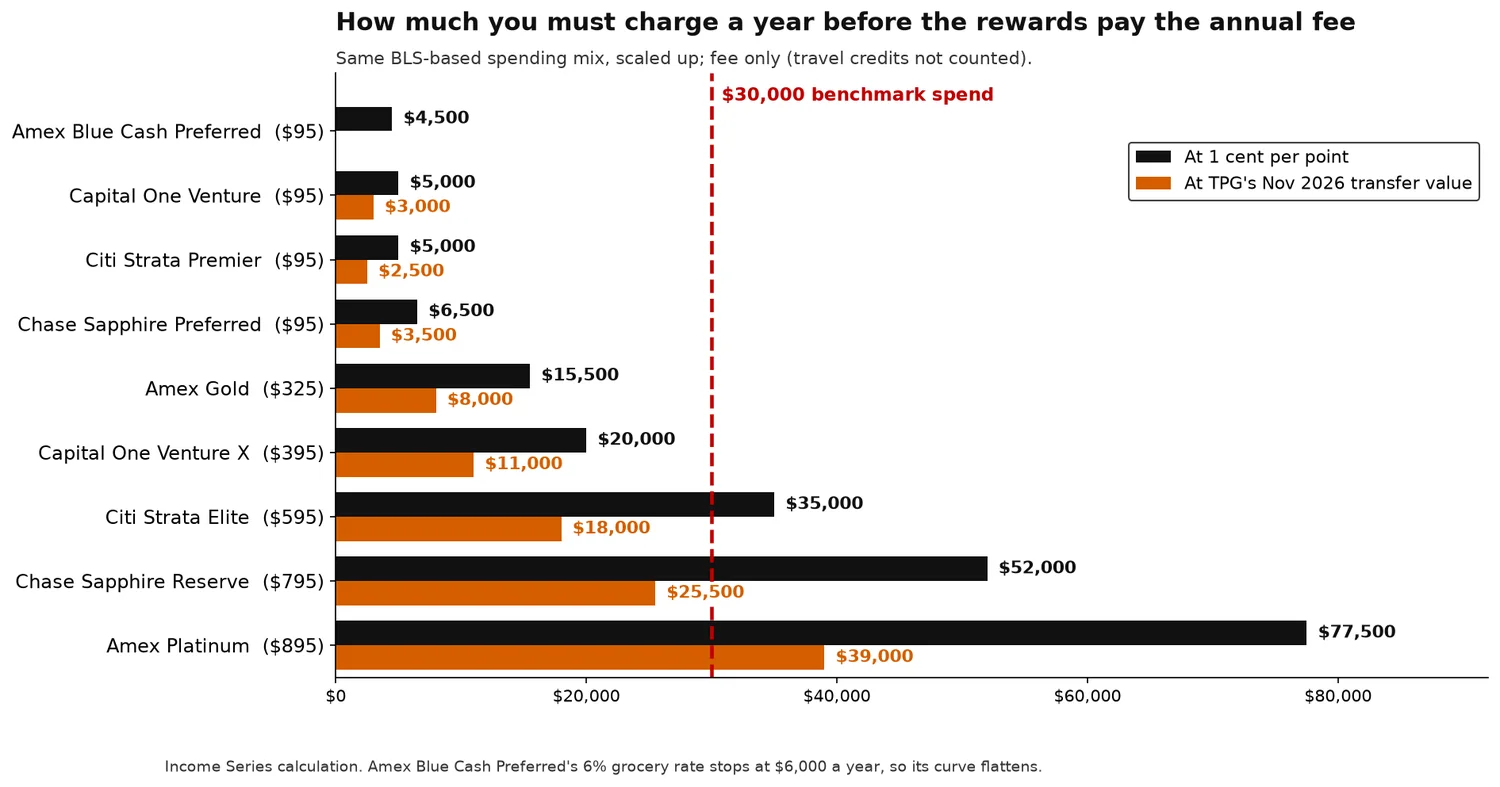
- The $95 cards recover their fee fastest. At transfer value, Citi Strata Premier covers its fee after $2,500 of spending, Capital One Venture after $3,000 and Sapphire Preferred after $3,500. The Sapphire Reserve needs $52,000 at 1 cent and $25,500 at 2.05 cents.
- Credits change the premium math. Counting only broad travel credits at face value as statement credits, Venture X rises to $605 at 1 cent, and Amex Platinum goes from -$547 to $253. Among the premium cards, only Venture X then beats a flat 2% card at 1 cent.
- How you redeem decides the winner. The same Sapphire Reserve nets -$335 at 1 cent and $148 at 2.05 cents. Our guide to using credit card points covers how to get above 1 cent.
Credit card annual fee vs. rewards: all 15 cards on $30,000
Each row below adds up the rewards the card earns on the same $30,000, subtracts the annual fee, and shows how much spending it takes before the rewards cover the fee. “Transfer value” applies The Points Guy’s November 2026 estimate for the card’s points program and appears only on the eight cards whose points move to airline and hotel partners.
| Card | Annual fee | Rewards earned on $30,000 (at 1¢) | Net after fee (at 1¢) | Net after fee (transfer value) | Spend to cover the fee (at 1¢) | Spend to cover the fee (transfer value) |
|---|---|---|---|---|---|---|
| No annual fee | ||||||
| Wells Fargo Active Cash | $0 | $600 | $600 | n/a | $0 | n/a |
| Citi Double Cash | $0 | $600 | $600 | n/a | $0 | n/a |
| Capital One Quicksilver | $0 | $450 | $450 | n/a | $0 | n/a |
| Chase Freedom Unlimited | $0 | $512 | $512 | n/a | $0 | n/a |
| Capital One Savor | $0 | $513 | $513 | n/a | $0 | n/a |
| Capital One VentureOne | $0 | $375 | $375 | n/a | $0 | n/a |
| Mid-range fee ($95 to $325) | ||||||
| Chase Sapphire Preferred | $95 | $459 | $364 | $845 | $6,500 | $3,500 |
| Capital One Venture | $95 | $600 | $505 | $1,015 | $5,000 | $3,000 |
| Citi Strata Premier | $95 | $614 | $519 | $1,102 | $5,000 | $2,500 |
| Amex Blue Cash Preferred | $95 | $650 | $555 | n/a | $4,500 | n/a |
| Amex Gold | $325 | $643 | $318 | $961 | $15,500 | $8,000 |
| Premium fee ($395 and up) | ||||||
| Capital One Venture X | $395 | $600 | $205 | $715 | $20,000 | $11,000 |
| Citi Strata Elite | $595 | $512 | -$83 | $404 | $35,000 | $18,000 |
| Chase Sapphire Reserve | $795 | $460 | -$335 | $148 | $52,000 | $25,500 |
| Amex Platinum | $895 | $348 | -$547 | -$199 | $77,500 | $39,000 |
Earning rates are from each issuer’s card page, checked November 27, 2026. Spending is from the BLS Consumer Expenditure Survey for 2025. Welcome bonuses and statement credits are left out of this table.
No-fee cards: where 2% sets the bar
Five of the six no-fee cards in the study pay a flat rate, or a flat rate plus a bonus category, and the results sit close together. Active Cash and Double Cash pay 2% cash back on everything, which is $600 on this spending. The Chase Freedom Unlimited pays 1.5% cash back with 3% on dining, and lands at $512. The Capital One Savor pays 3% cash back on groceries and dining and 1% on the rest, so it returns $513. The Quicksilver (1.5%) returns $450 and the VentureOne (1.25X miles) $375.
The lesson is that a bonus category only helps if you spend heavily in it. On this household’s mix, the Savor’s two 3% categories cover $10,633 of the $30,000, which is about 35% of the total. The other 65% earns 1%, and the average rate ends up below 2%.
Mid-range annual fees: the $95 cards, and the one at $325
This is where the annual fee starts to pay for itself, but only if you redeem for more than a cent. At 1 cent per point, the Sapphire Preferred nets $364, Venture $505, Strata Premier $519 and Blue Cash Preferred $555. All four land under $600. At transfer value the first three rise to $845, $1,015 and $1,102. Blue Cash Preferred stays at $555 because it pays cash back, not transferable points.
The Amex Gold works the other way. Its 4X on restaurants and U.S. supermarkets is the richest everyday rate in the study, so it earns $643 in gross rewards at 1 cent, more than every card except the Blue Cash Preferred. The $325 fee takes it to $318. At Amex’s transfer value of 2.0 cents it reaches $961.
One quirk of the Blue Cash Preferred: its 6% rate covers only the first $6,000 of supermarket spending each year, then drops to 1%. That cap is why it never catches a 2% card at any spending level, even though it nets more at $30,000 and 1 cent than any other fee card.
Premium annual fees: $395 to $895
Premium cards are priced on perks, not on everyday earning. Venture X pays 2X on everything, so it earns the same $600 as a 2% card and charges $395 for the privilege. The other three pay 1X to 1.5X outside their travel and dining categories. On a household that books little travel, that leaves a gap the fee has to cover: $895 on Amex Platinum, $795 on Sapphire Reserve, $595 on Strata Elite.

Travel credits are the premium cards’ answer. We counted only the broad ones, meaning credits that apply to ordinary travel purchases, and left out brand-specific credits you have to enroll in. With those counted at face value and used in full, Venture X nets $605, Amex Platinum $253, Citi Strata Elite $217 and the Sapphire Reserve -$35 at 1 cent. Frequent travelers who redeem points for more than a cent do better: at transfer value with credits, the same four net $1,115, $601, $704 and $448.
For a closer look at how these cards compare perk by perk, see our premium credit cards guide.
Is a credit card annual fee worth it? What the fee actually buys
The annual fee is a flat yearly charge for owning the card, whether or not you use it. In return, issuers bundle three kinds of benefit. The first is richer earning in categories like dining or travel. The second is statement credits, such as the $300 annual travel credit on the Sapphire Reserve and Venture X. The third is access: Capital One lists Priority Pass lounges with the Venture X, and American Express counts more than 1,550 airport lounges in the Platinum’s Global Lounge Collection.
Whether that is worth it comes down to which of those benefits you would have paid for anyway. A $300 travel credit is worth $300 to someone who books $300 of travel, and worth nothing to someone who doesn’t. A lounge visit saves a meal only if you fly. That is why we count credits separately from rewards in the tables above.
Welcome bonuses are the other piece. The Sapphire Preferred page advertises 75,000 points after $5,000 of purchases in the first three months, for example. A bonus like that can pay several years of a $95 fee, but it comes once, so we left it out of the yearly math. Some cards also soften the first year: American Express charges $0 for the first year on the Blue Cash Preferred and $95 after that.
Break-even spend: when does a card beat a flat 2% card?
A fee card has to beat the free alternative, not just break even against zero. The table shows the yearly spending, at this same mix, where a card’s rewards plus credits minus its fee first match a 2% no-fee card. “Never” means the card does not catch up at any spending level. “Any spend” means the credits cover the fee and the average rate is at least 2%.
| Card | Annual fee | Travel credits counted | At 1¢, no credits | At 1¢, with credits | Transfer value, no credits | Transfer value, with credits |
|---|---|---|---|---|---|---|
| Chase Sapphire Preferred | $95 | $100 | Never | Never | $8,500 | Any spend |
| Capital One Venture | $95 | $0 | Never | Never | $6,000 | $6,000 |
| Citi Strata Premier | $95 | $100 | $203,500 | Any spend | $5,000 | Any spend |
| Amex Blue Cash Preferred | $95 | $0 | Never | Never | n/a | n/a |
| Amex Gold | $325 | $0 | $227,000 | $227,000 | $14,500 | $14,500 |
| Capital One Venture X | $395 | $400 | Never | Any spend | $23,500 | Any spend |
| Citi Strata Elite | $595 | $300 | Never | Never | $45,000 | $22,500 |
| Chase Sapphire Reserve | $795 | $300 | Never | Never | $70,000 | $43,500 |
| Amex Platinum | $895 | $800 | Never | Never | $280,000 | $30,000 |
Travel credits assume you use them in full. Transfer value assumes you redeem at TPG’s November 2026 estimate for the program. Venture X’s “any spend” at 1 cent is a $5 margin: $605 against $600.
Method: how we ran the numbers
Every figure above comes from one short formula, applied the same way to every card:
Net value = (points earned × value per point) + credits counted − annual fee
1. The spending. The BLS Consumer Expenditure Survey for 2025, released October 29, 2026, reports average annual household spending by category. We took five lines that cards reward differently and set everything else to a round $30,000 total. The $30,000 is our assumption for card-friendly spending, about 37% of the $81,905 average household budget, which also covers housing, insurance and taxes.
| Spending line | Annual amount on the card |
|---|---|
| Groceries (food at home) | $6,491 |
| Dining (food away from home) | $4,142 |
| Gas (gasoline and other fuels) | $2,503 |
| Hotels and other lodging (“other lodging”) | $1,366 |
| Flights and other public transportation | $1,199 |
| Everything else (our assumption, so the total is $30,000) | $14,299 |
| Total | $30,000 |
2. The earning rates. We read each card’s current rates and caps from the issuer’s card page. Where a rate depends on how you book, we used the plain case: hotels and flights booked directly, not through the issuer’s travel portal.
| Card | Groceries | Dining | Gas | Hotels (booked direct) | Flights (booked direct) | Everything else |
|---|---|---|---|---|---|---|
| Wells Fargo Active Cash | 2X | 2X | 2X | 2X | 2X | 2X |
| Citi Double Cash | 2X | 2X | 2X | 2X | 2X | 2X |
| Capital One Quicksilver | 1.5X | 1.5X | 1.5X | 1.5X | 1.5X | 1.5X |
| Chase Freedom Unlimited | 1.5X | 3X | 1.5X | 1.5X | 1.5X | 1.5X |
| Capital One Savor | 3X | 3X | 1X | 1X | 1X | 1X |
| Capital One VentureOne | 1.25X | 1.25X | 1.25X | 1.25X | 1.25X | 1.25X |
| Chase Sapphire Preferred | 1X | 3X | 3X | 2X | 2X | 1X |
| Capital One Venture | 2X | 2X | 2X | 2X | 2X | 2X |
| Citi Strata Premier | 3X | 3X | 3X | 3X | 3X | 1X |
| Amex Blue Cash Preferred | 6X on the first $6,000, then 1X | 1X | 3X | 1X | 1X | 1X |
| Amex Gold | 4X | 4X | 1X | 1X | 3X | 1X |
| Capital One Venture X | 2X | 2X | 2X | 2X | 2X | 2X |
| Citi Strata Elite | 1.5X | 3X | 1.5X | 1.5X | 1.5X | 1.5X |
| Chase Sapphire Reserve | 1X | 3X | 1X | 4X | 4X | 1X |
| Amex Platinum | 1X | 1X | 1X | 1X | 5X | 1X |
X means points, miles or cents of cash back per $1: a 2X card on a cash-back page is 2% back. Sources: the issuer card pages listed below, checked November 27, 2026.
3. The value of a point. Two scenarios. The first is 1 cent per point, a fixed rate Chase and Capital One state themselves. The second is the transfer-partner estimate from The Points Guy for November 2026, which we apply to the eight cards whose points transfer to airline and hotel partners. Upgraded Points’ November 2026 numbers serve as a cross-check: with them, the Sapphire Reserve nets $125, the Amex Platinum -$129 and the Venture X $685, close to the TPG results.
| Program | 1¢ basis | The Points Guy, Nov 2026 | Upgraded Points, Nov 2026 |
|---|---|---|---|
| Chase Ultimate Rewards | 1¢: Chase says points are “worth $0.01 each” through Chase Travel | 2.05¢ | 2.0¢ |
| Capital One miles | 1¢: Capital One equates 10,000 miles to $100 toward travel (Venture X Business terms) | 1.85¢ | 1.8¢ |
| American Express Membership Rewards | 1¢: our assumption, because the card pages list no fixed rate | 2.0¢ | 2.2¢ |
| Citi ThankYou Points | 1¢: Citi Travel redemptions, per NerdWallet (cash redemptions on Strata Elite are 0.75¢) | 1.95¢ | 1.6¢ |
4. Break-even. Fee-recovery spending is the annual spending at which (points earned × value per point) equals the fee, with the same category mix scaled up. To beat a 2% card, a card’s net value has to reach 2% of total spending. The formula is: spending needed = (fee − credits) ÷ (the card’s average return − 2%).
Worked example, Chase Sapphire Reserve. On $30,000 the Reserve earns 45,979 points: 3X on dining (12,426 points), 4X on hotels and flights (10,260 points) and 1X on everything else (23,293 points). At 1 cent that’s $460. Subtract the $795 fee for -$335. At TPG’s 2.05 cents, the same points are worth $943, so the card nets $148. To cover the fee in rewards alone, it takes $795 ÷ (45,979 ÷ $30,000 × $0.01) = about $52,000 of spending at 1 cent.
Credits. Only broad travel credits are counted in the “with credits” columns, at face value:
| Card | Credits counted in the “with credits” columns | Not counted (brand-specific or enrollment required) |
|---|---|---|
| Capital One Venture X | $300 Capital One Travel credit; 10,000 anniversary miles at 1¢ ($100) | Lounge access (Capital One Lounges, Priority Pass) |
| Chase Sapphire Reserve | $300 Annual Travel Credit | $500 credit for stays with The Edit (prepaid bookings only); Priority Pass and Chase Sapphire Lounge access |
| Chase Sapphire Preferred | $100 Chase Travel Hotel Credit | Global Entry or TSA PreCheck fee credit (once every four years); DashPass |
| Citi Strata Premier | $100 Annual Hotel Benefit (one stay of $500 or more through cititravel.com) | None listed |
| Citi Strata Elite | $300 Annual Hotel Benefit (2 nights or more through cititravel.com) | $200 Splurge Credit, $200 Blacklane credit, Priority Pass, Admirals Club passes |
| Amex Platinum | $600 hotel credit (Fine Hotels + Resorts or The Hotel Collection) and $200 airline fee credit | $200 Uber Cash, $120 Uber One, $400 Resy, $300 digital entertainment, $300 lululemon, $155 Walmart+, $219 CLEAR+ (together $1,694) |
| Amex Gold | None (every listed credit is brand-specific) | $120 dining credit, $120 Uber Cash, $100 Resy |
| Capital One Venture | None (the $300 stays credit is a limited-time offer for new cardholders) | Limited-time offers |
What the model leaves out. Welcome bonuses, interest, authorized-user fees, drugstore, entertainment and streaming categories, online grocery at 3X on the Sapphire Preferred (we counted groceries at its 1X in-store rate), travel booked through issuer portals at the higher portal rates, and Citi’s Friday and Saturday dining rate. We treated the BLS “public and other transportation” line as airfare, which slightly favors cards with flight bonuses. Card terms change; the figures reflect the issuer pages on November 27, 2026.
How to run it on your own spending
- Pull 12 months of card or bank statements and total groceries, dining, gas, hotels and flights. Everything else goes in one pile.
- Multiply each total by the card’s rate from its page. Add the points.
- Value the points. Use 1 cent if you take cash back or portal bookings. Use your own redemption history if you book awards.
- Add only the credits you would have paid for anyway, then subtract the annual fee.
- Compare with 2% of your total spending. If the fee card’s net value is higher, the fee is worth paying for you.
If your gas spending is high, our best gas credit card comparison shows how category cards do on that line, and the travel cards for beginners list covers lower-fee ways to start earning travel points.
FAQ
Is a credit card annual fee worth it?
It is when the rewards and credits you will actually use exceed the fee plus what a free 2% card would have paid. On $30,000 of typical spending, that bar is $600. At 1 cent per point, no fee card cleared it unless travel credits are counted, and then only Venture X ($605) and Citi Strata Premier ($619) did. At transfer values, five of the eight transferable-points cards cleared it without any credits.
How do you calculate whether an annual fee pays for itself?
Add up the rewards you would earn in a year, multiply by what a point is worth to you, add the credits you will really use and subtract the annual fee. Then compare that net figure with 2% of your spending.
What is a good rewards rate on a no-annual-fee card?
Two percent is the top flat rate in this study. Wells Fargo Active Cash pays 2% cash rewards, and Citi Double Cash pays 1% when you buy and 1% when you pay. Cards at 1.5%, or 1.5% plus a bonus category, earn $450 to $512 on the same spending.
How much are credit card points worth?
Chase says its points are worth 1 cent each through Chase Travel. Transfer-partner redemptions can be worth more: The Points Guy’s November 2026 estimates are 2.05 cents for Chase, 2.0 for American Express, 1.95 for Citi and 1.85 for Capital One.
Do any cards waive the annual fee?
The Amex Blue Cash Preferred charges $0 for the first year and $95 after that, according to American Express. We used the ongoing $95 in this study.
Sources
- U.S. Bureau of Labor Statistics, Consumer Expenditures 2025 (released October 29, 2026)
- The Points Guy, points and miles valuations, November 2026
- Upgraded Points, points and miles valuations, November 2026
- Wells Fargo Active Cash Card
- Citi Double Cash Card
- Capital One Quicksilver, Savor, Venture, Venture X and the card comparison page (VentureOne, Venture X credits)
- Chase Freedom Unlimited, Sapphire Preferred and Sapphire Reserve
- Citi Strata Premier, Citi Strata Elite and Citi’s launch announcement for the Strata Elite ($595 annual fee)
- NerdWallet, Citi Strata Elite review (ThankYou point values at redemption)
- The Platinum Card from American Express, American Express Gold Card and Blue Cash Preferred