Business Credit Card Rewards: What Your 1% Card Is Costing You

Income Series may earn a commission from partners featured on this page; see our advertiser disclosure.
A business that runs $40,000 a month through a 1% card earns $4,800 a year in rewards. Put the same spending on a flat 2% card and it earns $9,600. Nothing about the business changes. The supplies, the software and the ad bills stay exactly the same. The only thing that changes is the card those bills are charged to. That gap is the whole story of business credit card rewards: most owners pick a card once, often the one their bank handed them, and never check what it earns.
This guide shows how business rewards actually work, how to match a card structure to the way your company spends, and what one private medical practice found when someone finally looked at its statement.
How business credit card rewards work
Every business rewards card pays you back in one of two currencies, and the difference matters more than the headline rate.
- Cash back. You earn a percentage of each purchase as cash. A dollar of rewards is worth a dollar. Simple, and impossible to misuse.
- Points or miles. You earn a number of points per dollar. What a point is worth depends on how you redeem it: about a cent as cash, sometimes more when you book travel or move points to an airline or hotel program.
On top of the currency sits the earning structure. There are only three you will run into:
- Flat rate. One rate on everything. Chase Ink Business Unlimited pays 1.5% cash back on every purchase with no annual fee. Capital One Spark Cash Plus pays 2% on every purchase for a $150 annual fee that Capital One refunds in any year you spend at least $150,000. Capital One Venture X Business earns 2X miles on everything for $395 a year.
- Category bonus with a cap. A higher rate in certain categories, up to a yearly limit. Ink Business Preferred earns 3 points per dollar on the first $150,000 a year in its combined bonus categories. The American Express Business Gold Card earns 4X on your top two spending categories each billing cycle from a list of six, again on the first $150,000 a year, then 1X.
- Premium category card. A big annual fee paired with a very high category rate. Chase’s Sapphire Reserve for Business costs $795 a year and earns 3X on social media and search engine advertising, on the first $1 million of those purchases each account anniversary year, and 1X on most other spending.
That’s the whole menu. Everything else on a card’s page (lounges, credits, insurance) is a benefit, not an earning rate. Hold onto that distinction; it comes back later.
What a 1% card is really costing you
Owners usually underestimate the gap because 1% sounds close to 2%. In dollars, it isn’t close at all. The chart below takes four common monthly spending levels and runs them through each structure for a year.
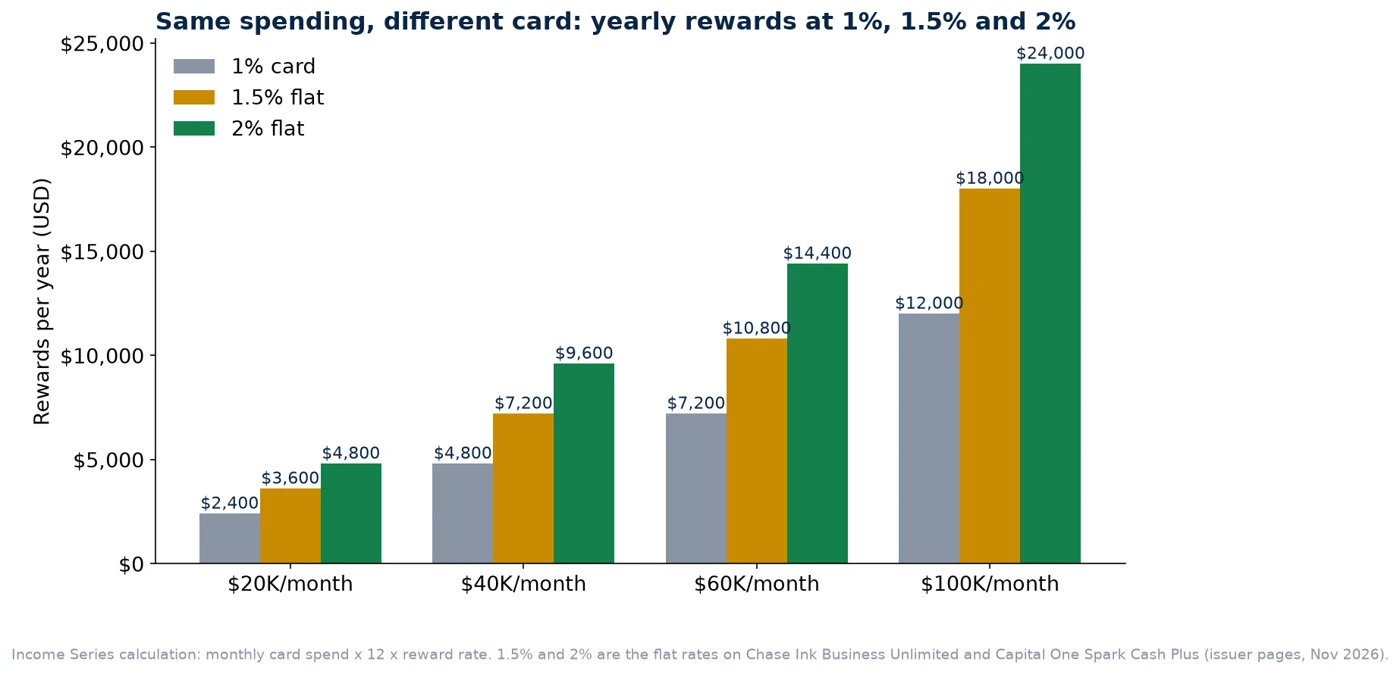
| Monthly card spend | Yearly spend | 1% card | 1.5% flat (Ink Business Unlimited) | 2% flat (Spark Cash Plus) | Left on the table at 1% |
|---|---|---|---|---|---|
| $20,000 | $240,000 | $2,400 | $3,600 | $4,800 | $2,400 |
| $40,000 | $480,000 | $4,800 | $7,200 | $9,600 | $4,800 |
| $60,000 | $720,000 | $7,200 | $10,800 | $14,400 | $7,200 |
| $100,000 | $1,200,000 | $12,000 | $18,000 | $24,000 | $12,000 |
Rates from Chase and Capital One card pages, November 2026. Spark Cash Plus’s $150 fee is refunded in years with $150,000+ of spending, which every row above clears. Welcome bonuses are left out on purpose: they happen once; the earning rate repeats every year.
Read the last column again. That money is already being spent. Nobody has to sell anything extra to get it.
A private practice case: $40,000 a month on a 1% card

Colin Stroud runs Go Somewhere, a credit card rewards consulting business. On The Koerner Office podcast (Ep. 300, May 2026) he described his first business-owner client: his own parents, who own a private medical practice together.
The practice was putting about $40,000 a month on a local bank’s 1% cash back card. Stroud’s words for it were blunt: this “is not rocket science,” and a busy owner like his dad simply “does not care and doesn’t have time to think about this.” He moved the spending to a 50/50 setup between Capital One and Chase, split across the practice’s two business entities, and paired it with a Chase personal-card promotion that was running at the time and has since ended.
The result, by his account: “well over a million points” in the first year, and a resort trip in Cap Cana, Dominican Republic that he valued at about $9,000, paid for with points. He has since helped them book business class flights to Europe for a cruise.
The math lines up with what he described. At 2 points per dollar, $480,000 of yearly spending is 960,000 points before any welcome bonus or promotion. The old card paid $4,800 for the same spending.
Why practices are a good fit for this
Medical, dental and veterinary practices tend to have three things in common: large recurring supply orders, software and service subscriptions, and owners who are too busy treating patients to read card terms. Those supplier bills are exactly the kind of spending a flat 2% card was built for, because they rarely land in a bonus category. If a vendor accepts cards without a surcharge, moving that vendor from ACH or check to the card is the single biggest lever a practice has.
Match business credit card rewards to how you spend
The right structure depends almost entirely on where your dollars go. Here is the quick way to read your own statement.
| If most of your spending is… | Structure that usually earns most | Example cards (Nov 2026 terms) | Watch this number |
|---|---|---|---|
| Supplies, materials, inventory, vendors (no bonus category) | Flat 2%, or 2X transferable miles | Spark Cash Plus (2% cash), Venture X Business (2X miles) | Your yearly total: above $150K the Spark fee is refunded |
| Under about $150K a year, spread around | No-fee flat 1.5% | Ink Business Unlimited ($0 fee) | The 0.5% gap vs a 2% card |
| Online ads (Google, Meta) up to $150K a year | Category card with a $150K cap | Amex Business Gold (4X), Ink Business Preferred (3X) | The $150,000 yearly cap |
| Online ads well above $150K a year | Premium ad-category card | Sapphire Reserve for Business (3X on first $1M of ads) | $795 fee vs extra points |
| Two entities, or very mixed spending | Two cards, each doing one job | Flat card for vendors + category card for ads | Which bills land on which card |
The cap trap: why a 4X card can earn less than a 2X card
This is where well-meaning owners lose the most. A 4X card sounds twice as good as a 2X card. It is, until the cap. Stroud walked through this exact case on the podcast with a host spending heavily on Facebook ads with an Amex Business Gold: past $150,000 a year in bonus spending, the card drops to 1X for the rest of the year.
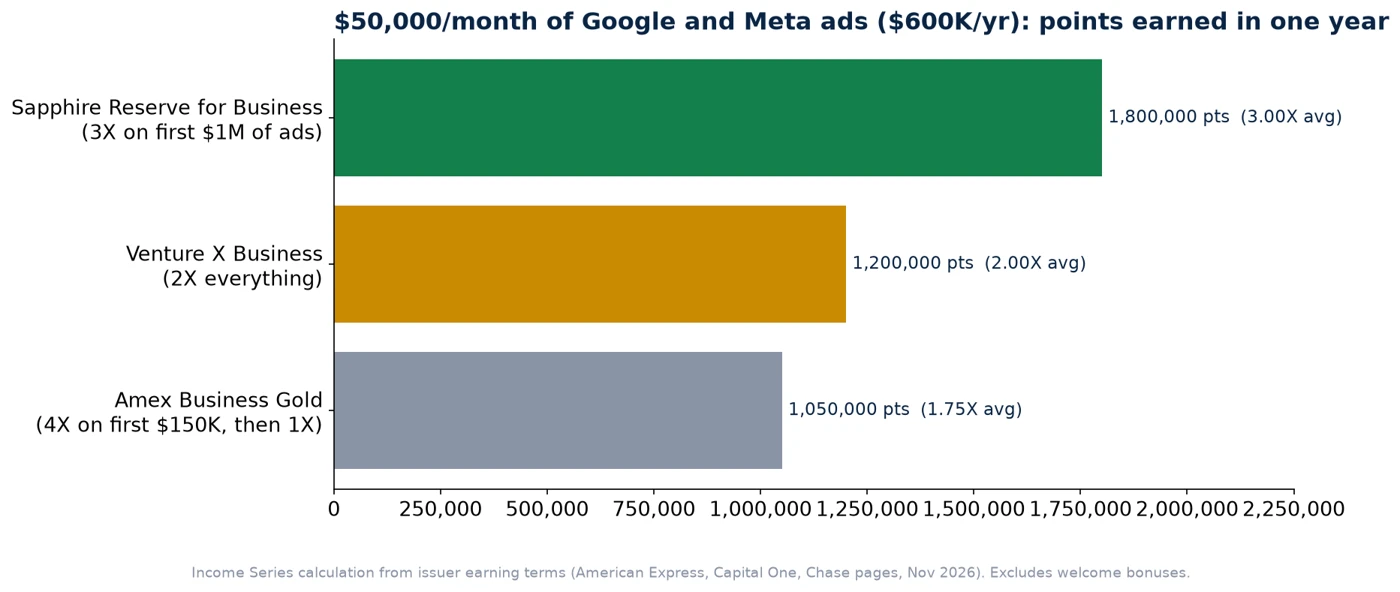
Run $50,000 a month of ads ($600,000 a year) through each card:
- Amex Business Gold: 4X on the first $150,000 (600,000 points) plus 1X on the other $450,000 (450,000 points) = 1,050,000 points. That is an average of 1.75 points per dollar.
- Venture X Business: 2X on all $600,000 = 1,200,000 miles.
- Sapphire Reserve for Business: 3X on all $600,000, well inside its $1 million ad cap = 1,800,000 points.
Stroud called the Reserve for Business’s ad rate uncapped when he recorded that episode. Chase has since added the $1 million yearly cap (effective November 15, 2026), which only matters if your ad budget is above $83,000 a month.
What else to compare besides the earning rate
- Annual fee vs. extra rewards. An annual fee is worth paying only if the card’s extra cash back or points beat a no-fee card on your real spending. Spark Cash Plus’s $150 annual fee disappears at $150,000 a year of spending; Ink Business Unlimited has no annual fee at all.
- Employee cards. If staff buy supplies or book travel, check whether employee cards are free and whether their spending earns rewards on your account. Chase lists employee cards at no additional cost on Sapphire Reserve for Business.
- Welcome bonus spending requirements. A welcome bonus is a one-time boost. Ink Business Unlimited’s $750 cash back bonus needs $6,000 of purchases in three months; Ink Business Preferred’s 100,000-point bonus needs $8,000. Sapphire Reserve for Business currently asks $30,000 in six months for 150,000 points. Pick a bonus your normal business expenses will clear.
- Travel benefits. If owners or staff travel for conferences, travel earning and travel credits can matter as much as the base rate. Venture X Business adds a $300 annual travel credit through Capital One Business Travel and 10,000 anniversary miles.
- Your credit score. Traditional bank business cards often require a personal guarantee, which makes the owner personally responsible for the balance, so your own credit score is part of the application.
Perks are not earnings
The most common pushback Stroud says he hears goes like this: an owner spending $60,000 a month on an Amex Business Platinum, earning one point per dollar on most of it, defends the card because of the lounges and travel insurance. His answer: you’d get every one of those perks if you spent $0 on the card. Spending is what earns; perks come with the fee.
That doesn’t make premium cards bad. It means you can carry one for the perks and still run the bulk of your spending through a card that earns 2X. Many owners do exactly that.
Cash back or points for a business?
Here’s an honest way to decide. If you will actually book trips and are willing to learn (or pay someone) to move points to airline and hotel partners, transferable points usually beat cash, because a point can be worth more than a cent. If you won’t, take the cash. Stroud’s own advice to owners who hoard points was to use them, even at a middle-of-the-road value, or switch to cash back, because loyalty programs keep raising award prices and points sitting in an account lose value over time.
One Chase detail is worth knowing. Ink Business Unlimited earns cash back, but if you also hold a Chase card that transfers points (Sapphire Preferred, Sapphire Reserve or Ink Business Preferred), Chase lets you combine those rewards into that account, where they can move to airline and hotel partners. Stroud called this out as one of his favorite setups for smaller businesses, and said it’s the card he runs his own business on.
How to switch without disrupting your books
- Pull 12 months of statements. Total your card spending and sort it into four buckets: advertising, travel, supplies/vendors, everything else.
- List the bills you pay by ACH or check that could go on a card with no surcharge. That number is often bigger than the card spending itself.
- Pick a structure from the table above, using your largest bucket first.
- Apply under the right entity. If you run more than one business, each can hold its own card, the way the practice above split spending across two entities. (See how to build business credit and opening a business bank account for an LLC if the entity is new.)
- Move autopays in one sitting. Software, utilities, suppliers. Do it in an afternoon and the new card starts earning on the next billing cycle.
- Put the bookkeeping on autopilot by paying the card in full from the business account each month, so rewards never turn into interest.
FAQ
What is the best business credit card to earn rewards?
The one that matches your biggest spending bucket. For general vendor and supply spending, a flat 2% card (Capital One Spark Cash Plus) or 2X miles card (Venture X Business) usually earns the most. For online advertising under $150,000 a year, a 3X or 4X category card fits. For ad budgets above that, Sapphire Reserve for Business earns 3X on up to $1 million a year.
How much does a 1% card cost a business?
Exactly 1% of your yearly card spending compared with a 2% card. At $20,000 a month that is $2,400 a year; at $40,000 a month, $4,800; at $100,000 a month, $12,000.
Do I need a premium card to earn 2%?
No. Spark Cash Plus earns 2% for a $150 fee that is refunded in any year you spend $150,000 or more, and Ink Business Unlimited earns 1.5% with no annual fee. Premium cards earn more only in specific categories.
Do business credit card points expire?
Chase’s rewards agreement for Sapphire Reserve for Business says points don’t expire while the account stays open, and Capital One says Spark Cash Plus rewards don’t expire for the life of the account. Stroud’s point still stands, though: award prices tend to rise, so spending points sooner usually beats saving them.
Can a medical practice put supplies and vendor bills on a business card?
Yes, whenever the vendor accepts cards. Many practices pay suppliers by ACH out of habit. Moving vendors who take cards without a surcharge onto a 2% card is usually the largest single increase in rewards a practice can make.
Sources
- The Koerner Office, Ep. 300: The Credit Card Side Hustle No One Talks About (Colin Stroud), May 2026
- Chase Ink Business Unlimited and Ink Business Preferred
- Chase Sapphire Reserve for Business and its Rewards Program Agreement
- Capital One Spark Cash Plus and Venture X Business
- American Express Business Gold Card