Best Balance Transfer Credit Cards: 0% APR Offers Compared

Quick answer: The best balance transfer credit cards right now give you 21 months at 0% intro APR. That’s the Wells Fargo Reflect, Citi Diamond Preferred, Chase Slate, U.S. Bank Shield and BankAmericard. Citi Diamond Preferred stands out because its intro transfer fee is 3% instead of 5%. If you also want to earn rewards after the intro period ends, look at the Citi Double Cash or the Wells Fargo Active Cash.
We checked all terms on each issuer’s website on November 18, 2026. Intro offers change often, and some Citi offers vary by page, so confirm the terms on the application before you apply.
Best balance transfer credit cards compared
| Card | Intro APR on transfers | Intro APR on purchases | Transfer fee | Ongoing variable APR | Annual fee |
|---|---|---|---|---|---|
| Wells Fargo Reflect | 0% for 21 months (transfers made within 120 days) | 0% for 21 months | 5%, min $5 | 17.74%, 24.24% or 28.49% | $0 |
| Citi Diamond Preferred | 0% for 21 months (transfers completed within 4 months) | 0% for 12 months | 3% intro (min $5) for 4 months, then 5% | 16.74%–27.49% | $0 |
| Chase Slate | 0% for 21 months | 0% for 21 months | $5 or 5%, whichever is greater | 18.49%–28.49% | $0 |
| U.S. Bank Shield Visa | 0% for 21 billing cycles (transfers within 60 days) | 0% for 21 billing cycles | 5%, min $5 | 17.24%–28.24% | $0 |
| BankAmericard | 0% for 21 billing cycles (transfers within 60 days) | 0% for 21 billing cycles | 5% | 15.24%–26.24% | $0 |
| Citi Simplicity | 0% for 18 months (transfers within 4 months) | 0% for 18 months | 3% intro (min $5) for 4 months, then 5% | 17.74%–28.49% | $0 |
| Citi Double Cash | 0% for 18 months (transfers within 4 months) | None | 3% intro (min $5) for 4 months, then 5% | 18.49%–28.74% | $0 |
| Wells Fargo Active Cash | 0% for 12 months | 0% for 12 months | 3% intro (min $5) for 120 days, then up to 5% | 18.74%, 24.74% or 28.74% | $0 |
What a balance transfer actually saves you
Credit card interest is expensive. The Federal Reserve’s latest data puts the average rate on accounts that are assessed interest at about 22% (Federal Reserve G.19). We modeled a $5,000 balance at 24.99% APR and compared four ways to pay it off. Each balance transfer scenario uses a fixed monthly payment that clears the debt, fee included, before the 0% period ends.
| Scenario | Upfront fee | Monthly payment | Interest paid | Total cost |
|---|---|---|---|---|
| Keep it on a 24.99% card ($250/month) | $0 | $250.00 for 27 months | $1,534.53 | $1,534.53 |
| 21-month card with a 5% fee | $250 | $250.00 | $0 | $250 |
| 21-month card with a 3% intro fee (Citi Diamond Preferred) | $150 | $245.24 | $0 | $150 |
| 18-month card with a 3% intro fee (Citi Simplicity, Double Cash) | $150 | $286.11 | $0 | $150 |
| 12-month card with a 3% intro fee (Active Cash) | $150 | $429.17 | $0 | $150 |
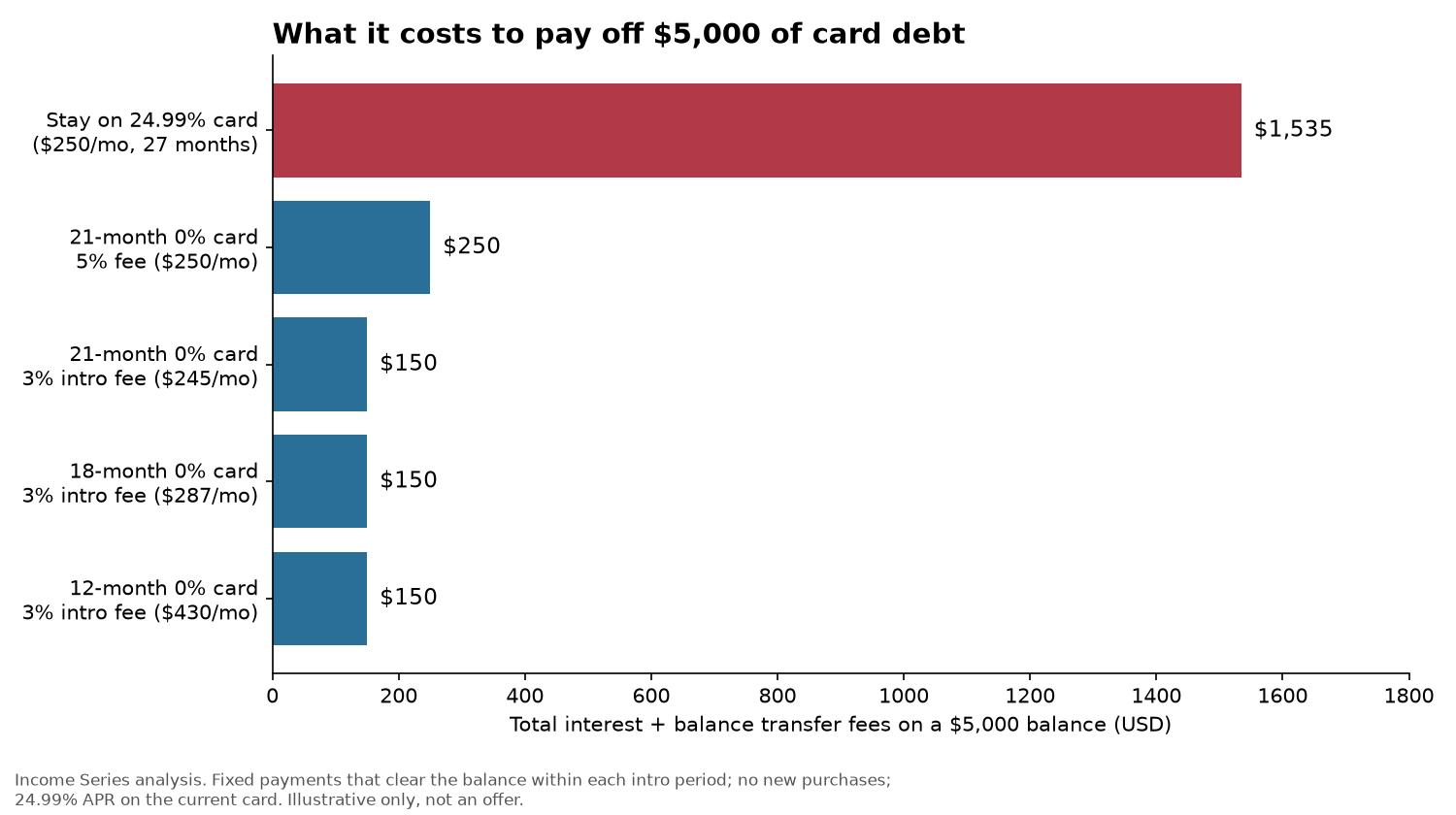
The fee is the price of the transfer, and here it’s small next to the interest you avoid. A 21-month card with a 5% fee saves about $1,285 compared with staying put. A 21-month card with a 3% fee saves about $1,385. The catch is the payment. If you’d only pay $250 a month on an 18-month card, you’d still owe about $650 (the $5,150 balance including the fee, minus 18 payments of $250) when the intro rate ends, and that balance would start accruing interest at the ongoing APR.
The best balance transfer cards, reviewed
Wells Fargo Reflect: longest intro period with purchases too
You get 0% intro APR for 21 months on purchases and on qualifying transfers made within 120 days of opening the account. After that, the variable APR is 17.74%, 24.24% or 28.49% depending on your credit. The transfer fee is 5% (minimum $5), and there’s no annual fee. Pick this card if you want the longest runway on both new purchases and old debt.
Citi Diamond Preferred: lowest fee on a 21-month transfer
Transfers get 0% for 21 months if you complete them within four months of opening the account, and purchases get 0% for 12 months. The intro transfer fee is 3% (minimum $5) during those first four months, then 5%. Afterward, the variable APR is 16.74%–27.49%. Citi says transfers start processing 14 days after the account opens, so keep paying your old card until the transfer posts.
Chase Slate: simple 21-month offer from Chase
Chase gives you 0% intro APR for 21 months on both purchases and transfers, then 18.49%–28.49% variable. The transfer fee is $5 or 5%, whichever is greater. One warning from Chase’s terms: the intro APR can end early if a payment is 60 days late.
U.S. Bank Shield Visa: 21 billing cycles plus perks
You get 0% for 21 billing cycles on purchases and on transfers made within 60 days, then 17.24%–28.24% variable. The transfer fee is 5% (minimum $5). The card also adds a $20 annual statement credit for 11 consecutive months of purchases, 4% back on prepaid travel booked through the U.S. Bank Travel Center, and cell phone protection.
BankAmericard: lowest ongoing APR range
You get 0% for 21 billing cycles on purchases and on transfers made within 60 days. The ongoing range of 15.24%–26.24% variable starts lower than any other card here, which matters if you might not clear the balance in time. The transfer fee is 5%.
Citi Simplicity: no late fees
You get 0% for 18 months on purchases and on transfers made within four months, then 17.74%–28.49% variable. The intro transfer fee is 3% (minimum $5), then 5%. Citi Simplicity charges no late fees and has no penalty rate. That’s a safety net while you’re juggling payments, but it doesn’t protect your credit if you pay late.
Citi Double Cash: best for rewards after the transfer
Transfers get 0% for 18 months if made within four months, but purchases get no intro APR. The intro transfer fee is 3% (minimum $5), then 5%. After the debt is gone, you earn 2% cash back on purchases: 1% when you buy and 1% as you pay. Transferred balances don’t earn cash back. The ongoing APR is 18.49%–28.74% variable.
Wells Fargo Active Cash: shorter intro, strong everyday card
You get 0% for 12 months on purchases and qualifying transfers. The intro transfer fee is 3% (minimum $5) for 120 days, then up to 5%. Active Cash earns unlimited 2% cash rewards, and the current welcome bonus is $100 after you spend $500 in the first three months. Choose it only if you can pay off the balance within a year.

How to do a balance transfer, step by step
- Add up what you owe and the APR on each card.
- Divide the total plus the fee by the intro months. If you can’t afford that monthly payment, pick a longer offer.
- Apply with a different issuer. Most banks won’t let you transfer a balance between two of their own cards.
- Request the transfer right away. Most intro rates require you to transfer within 60 days, 120 days or 4 months of opening.
- Keep paying the old card until the transfer shows as complete.
- Set up autopay for your planned amount, not just the minimum.
- Stop using the old card for new debt. Keep it open to protect your utilization and credit age.
Someone we worked with moved a lingering balance onto a 0% card, then split the payoff into equal monthly payments and set them up as an automatic transfer on payday. The debt was gone before the promotion ended. The only thing it cost was the transfer fee.
Balance transfer pros and cons
| Pros | Cons |
|---|---|
| Up to 21 months with no interest | Transfer fees of 3%–5% |
| One payment instead of several | The ongoing APR applies to any balance left after the intro period |
| A new credit line can lower overall utilization | Hard inquiry and a newer average account age |
| Fixed payoff date | Transfer limit may be lower than your debt |
Do balance transfers hurt your credit score?
A new card usually causes a small, temporary dip from the hard inquiry and the new account. Over time, a balance transfer often helps. Your total available credit goes up, and paying the debt down faster lowers your utilization. Amounts owed make up about 30% of a FICO score (myFICO). The real damage comes from missed payments or from running the old card back up. If your score is still recovering, start with our best credit cards to build credit guide.
When a balance transfer isn’t the right move
- You can pay the debt off in two or three months anyway. The fee may cost more than the interest.
- Your score is below the range these cards look for (generally good to excellent credit).
- The debt is too large to clear in 21 months. A fixed-rate option may fit better. Compare personal loans vs. credit cards.
- Spending is still running ahead of income. See our strategies for eliminating credit card debt first.
For how interest and APR work, the CFPB’s explainer is a good primer.
Frequently asked questions
Who has the best balance transfer card right now?
For the longest 0% period, the Wells Fargo Reflect, Citi Diamond Preferred, Chase Slate, U.S. Bank Shield and BankAmericard all offer 21 months or 21 billing cycles. Citi Diamond Preferred has the lowest intro transfer fee of the group at 3%.
Are balance transfers bad for your credit score?
Not usually. Expect a small dip from the application. Lower utilization and on-time payments typically more than make up for it over the following months.
Can I transfer a balance between cards from the same bank?
Generally no. Major issuers don’t allow transfers between their own cards, so pick a card from a different bank than the one holding your debt.
What happens if I don’t pay off the balance before the intro APR ends?
Whatever is left starts accruing interest at the card’s ongoing variable APR from that point. These offers aren’t deferred interest, so you won’t be charged back interest for the intro months.
What is the 7-year rule for credit cards?
Most negative items, such as late payments and accounts sent to collections, can stay on your credit reports for up to seven years. That’s another reason to never miss a payment during a balance transfer.