Premium Credit Cards: How They Work and the Break-Even Math

Income Series may earn a commission from partners featured on this page; see our advertiser disclosure.
Premium credit cards are the cards with the big annual fees: $395, $795, even $895 a year. In return you get travel credits, airport lounges, richer earning on travel and points you can move to airlines and hotels. Whether that trade works for you comes down to one piece of arithmetic most comparison pages skip. This guide walks through it, card by card, so you can see your own break-even number before you apply.
What makes a credit card “premium”?
There’s no official definition, but the cards everyone puts in this group share four traits:
- A high annual fee, usually several hundred dollars.
- Annual credits that give back part of that fee if you spend in specific ways: a travel credit, a ride-share credit, a hotel credit.
- Travel perks such as airport lounge access and elevated earning on flights and hotels.
- Transferable points that can move to airline and hotel loyalty programs, where a point can be worth more than a cent.
They’re built for people with established credit who pay their balance in full each month and travel several times a year. Issuers aim them at applicants with excellent credit; Capital One, for example, lists the credit level for Venture X as “Excellent.” That’s the reader this page is written for.
The three premium cards most people compare
| Card | Annual fee | Base earning (everyday spending) | Where it earns more | Built-in value that offsets the fee |
|---|---|---|---|---|
| Capital One Venture X | $395 | 2X miles on everything | 10X hotels and rental cars, 5X flights and vacation rentals through Capital One Travel | $300 yearly Capital One Travel credit; 10,000 bonus miles each anniversary; lounge access |
| Chase Sapphire Reserve | $795 | 1X | 8X on Chase Travel, 4X flights and hotels booked direct, 3X dining | $300 Annual Travel Credit; up to $500 credit for stays booked through The Edit; Priority Pass lounge access; 1:1 transfers to World of Hyatt |
| The Platinum Card from American Express | $895 | 1X | 5X on flights and prepaid hotels (on up to $500,000 a year) | Statement credits such as $15 in Uber Cash each month plus $20 in December and a $200 airline fee credit; Global Lounge Collection; transfers to 20 airline and hotel partners |
Fees and earning rates from each issuer’s card page, November 2026. Credit lists change often; check the card page for the current set before you count them.
Premium perks, side by side
The earning rates get the attention, but the perk lists are where these cards really differ. Here’s what each one includes, pulled from the issuers’ own pages.
| Perk | Venture X ($395) | Sapphire Reserve ($795) | Amex Platinum ($895) |
|---|---|---|---|
| Airport lounges | Capital One Lounges plus 1,300+ Priority Pass lounges | 1,300+ Priority Pass lounges and Chase Sapphire Lounges | Global Lounge Collection: 1,550+ lounges, including Centurion Lounges |
| Main travel credit | $300 a year, booked through Capital One Travel | $300 Annual Travel Credit | $200 airline fee credit; up to $300 semi-annually on prepaid Fine Hotels + Resorts bookings |
| Hotel elite status | None listed | IHG One Rewards Platinum Elite (through 12/31/27) | Hilton Honors Gold and Marriott Bonvoy Gold Elite (enrollment required) |
| Recurring bonus points | 10,000 miles each anniversary | None | None |
| Transfer partners | Yes (23 airline and hotel programs on Capital One’s list) | Yes (Chase’s 14 programs) | Yes (20 airline and hotel programs) |
From Capital One, Chase and American Express card pages, November 2026. Some benefits need enrollment.
How to value a credit honestly
A $300 credit is worth $300 only if it replaces money you’d have spent. If it pushes you to book a hotel through a portal you’d never use, or to buy something you didn’t need, discount it hard. A useful rule: write down what you spent last year in each credit’s category. That number, capped at the credit amount, is the credit’s real value to you.
Elite status works the same way. Hotel status means room upgrades when available and other perks at that chain. If you stay at that chain several nights a year, it’s real value. If you don’t, it’s a line on a benefits page.
The break-even math

Here’s the worksheet. Fill in the rows honestly and the answer falls out.
| Line | What goes here | Rule |
|---|---|---|
| A. Annual fee | The card’s fee | Full amount |
| B. Credits you will actually use | Only credits for things you already buy | Count at face value only if you’d spend that money anyway |
| C. Recurring bonus points | Anniversary bonuses | At 1 cent per point unless you transfer points |
| D. Extra earning vs your current card | (Premium card points – current card rewards) on your real spending | Use your last 12 months of statements |
| Net cost = A – B – C – D | Negative means the card pays you |
Worked example: Venture X for a moderate traveler
Fee $395. If you book at least $300 a year through Capital One Travel anyway, the travel credit is worth $300. The 10,000 anniversary miles are worth $100 toward travel (Capital One prices the same 10,000-mile bonus on its Venture X Business card at $100). That’s $395 – $300 – $100 = -$5 before you earn a single mile. Every 2X purchase after that is profit compared with a no-fee 2% card, and the lounge access is a free extra.
Worked example: Amex Platinum for someone who rarely uses Uber
Fee $895. Suppose you’d use the Uber Cash ($15 a month plus $20 in December, or $200 a year) but none of the other credits. Net cost before earning: $695. To make that back on earning alone, you’d need a lot of flights and prepaid hotels at 5X. For a frequent flyer who books through the airline and uses several credits, the same card can come out ahead. For a light traveler, it’s a $695 lounge membership.
The pattern holds across every premium card: the annual fee is fixed, the credits are conditional. Count only the conditions you already meet. A statement credit you’d never trigger is worth zero, no matter what the card page calls it.
When the annual fee goes up
Issuers raise premium annual fees from time to time and usually add credits alongside. Rerun the worksheet each year before your card’s anniversary, using what you actually redeemed last year. If the net cost turned positive, compare it with a lower-fee card before the next fee posts.
Perks are not earnings
This is the trap Colin Stroud, who runs the rewards consultancy Go Somewhere, says he sees every week. On The Koerner Office podcast (Ep. 300) he described a business owner putting $60,000 a month on a premium Amex and earning one point per dollar, who defended the card because of the lounges and travel insurance. Stroud’s reply: those perks would be his even if he spent $0 on the card.
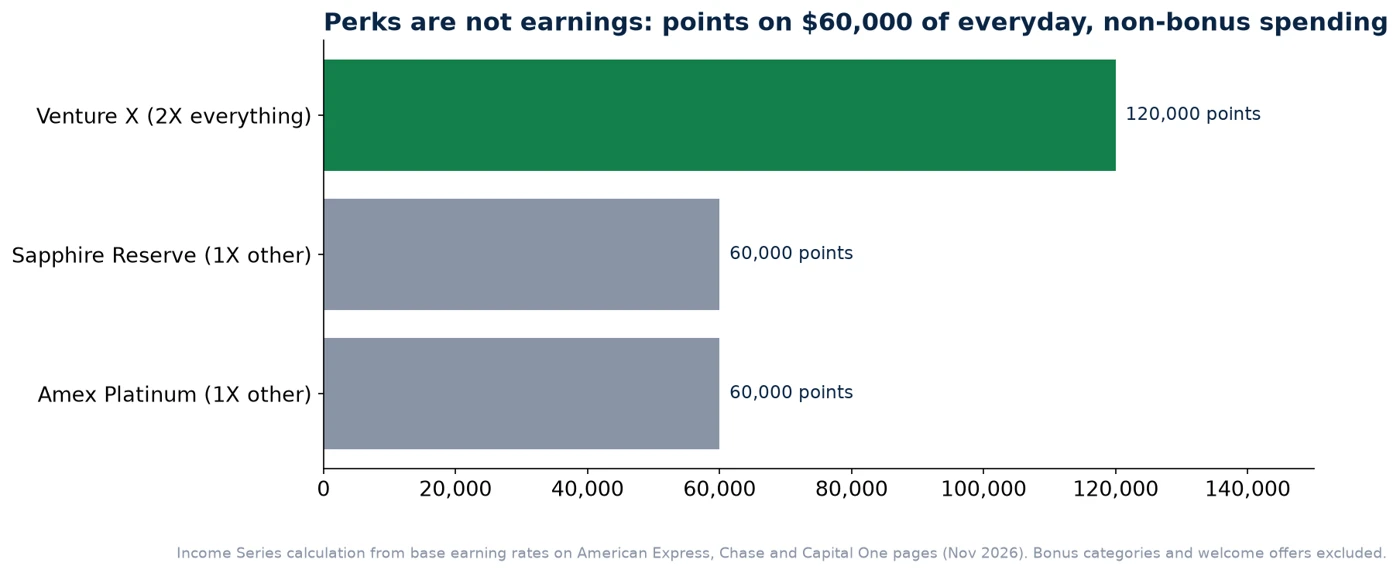
Put plainly: a premium card’s earning rate on groceries, utilities, insurance and everything else that isn’t travel or dining is often 1X. If most of your spending lives there, the card you carry and the card you spend on can be different cards. Plenty of people keep a premium card for travel purchases and perks, then run everyday spending through a 2X card.
Stroud also made a point worth repeating for anyone feeling pressure to upgrade: you don’t need one of these cards to get good value from rewards. A no-fee or low-fee card that earns 1.5% to 2% on everything beats a premium card for many households.
Who premium cards fit (and who they don’t)
Good fit:
- You travel at least a few times a year and already spend money in the credit categories.
- You’ll use transfer partners, or the issuer’s travel portal, instead of cashing points out at a cent.
- Your yearly spending in the card’s bonus categories (flights, hotels, dining, travel portal) is large.
Better served by a no-fee or mid-fee card:
- You fly once a year and don’t want to plan around credits.
- Most of your spending is everyday, non-travel spending.
- You’d rather have cash than points. See our guide to travel credit cards for beginners for lower-fee options.
Getting full value from the points
The card only pays off if the points do. Cashing out usually gets about a cent per point; transferring to the right airline or hotel partner can get more. Our guide to the best way to use credit card points walks through each redemption option with real numbers. Two quick rules from Stroud: use points regularly rather than hoarding them, since award prices tend to rise, and use an award search tool instead of checking airline sites one by one.
FAQ
What are considered premium credit cards?
Cards with high annual fees (roughly $395 and up) that bundle travel credits, lounge access, elevated travel earning and transferable points. The Capital One Venture X, Chase Sapphire Reserve and The Platinum Card from American Express are the three most compared.
What’s the most premium credit card?
Among cards anyone can apply for, The Platinum Card from American Express has the highest fee of the three above at $895. Above that sit invitation-only cards such as the American Express Centurion Card.
Are premium credit cards worth it?
They are when the credits you’d use anyway, plus the extra points you earn, add up to more than the fee. Use the worksheet above with your last 12 months of spending. For many moderate travelers the Venture X comes out close to free; the $795 and $895 cards need heavier travel or more credit use.
Do premium credit cards come with lounge access?
All three covered here do. Venture X and Sapphire Reserve include Priority Pass lounges (1,300+ worldwide) plus each issuer’s own lounges; The Platinum Card includes the American Express Global Lounge Collection of more than 1,550 lounges. Guest rules differ by card.
Is a premium card better than a 2% cash back card?
For travel spending and for people who transfer points, often yes. For everyday spending outside bonus categories, a 2% or 2X card usually earns more, since several premium cards earn 1X there.