The Best Way to Use Credit Card Points (With Real Values)

Income Series may earn a commission from partners featured on this page; see our advertiser disclosure.
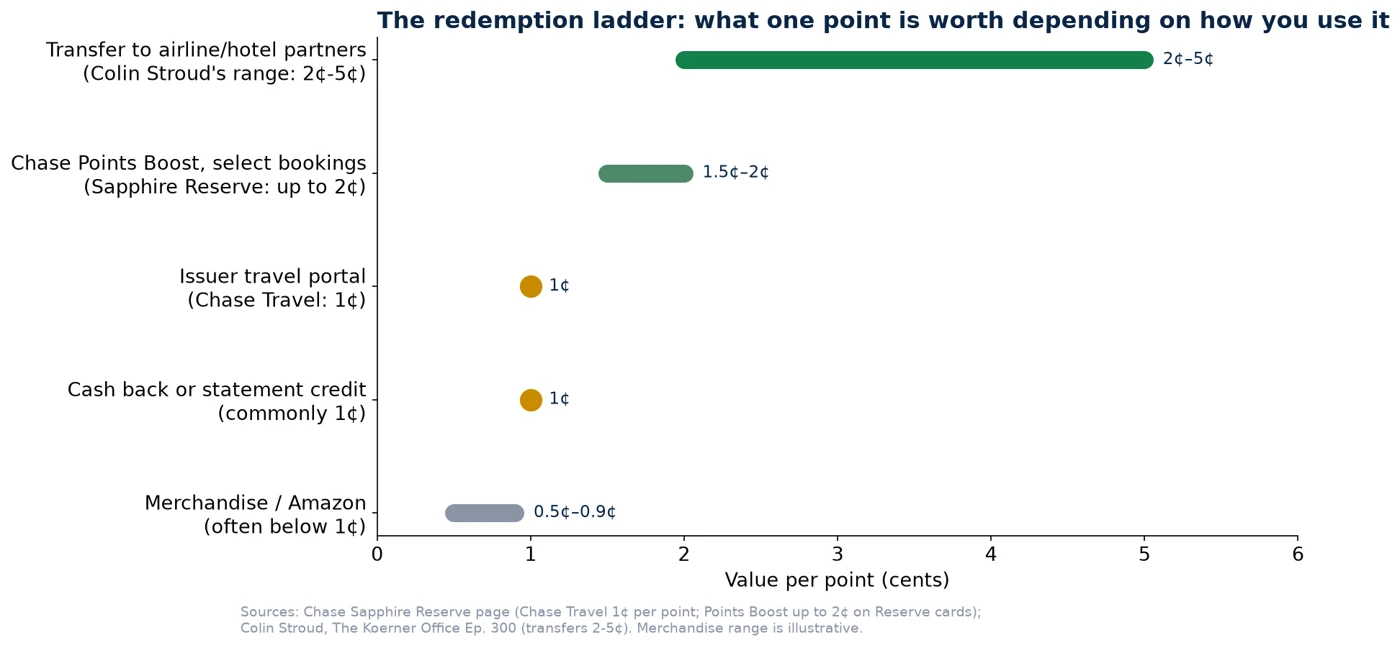
The best way to use credit card points is usually to transfer them to an airline or hotel loyalty program and book an award, where a point can be worth 2 cents or more. The simplest way is cash back or a statement credit at about 1 cent per point. The worst ways are merchandise and shopping checkouts, which often pay less than a cent. Everything else is a question of how much effort you want to trade for value.
Below is the full ladder, with a formula to check any redemption yourself, a map of which bank transfers to which airline, and the habits that keep points from losing value while they sit in your account.
How credit card points work, in one minute
You earn a set number of points per dollar, more in bonus categories. The points have no fixed cash value. What each one is worth depends on what you turn it into. That’s why two people with the same 100,000 points can walk away with $1,000 in cash or a business class seat worth several times that.
To compare options, use cents per point:
Value per point = (cash price you avoided – taxes and fees you still paid) / points used
Example: a flight that sells for $1,200 costs 60,000 miles plus $80 in taxes. ($1,200 – $80) / 60,000 = 1.87 cents per point. Run that same check on every redemption you’re considering and the best one is obvious.
The best way to use credit card points: the redemption ladder
| Redemption | Typical value per point | Effort | Use it when |
|---|---|---|---|
| Transfer to airline or hotel partner | 2 to 5 cents (Colin Stroud’s range for good awards) | High: find award space, then transfer | You can be flexible on dates or routes, especially for business class and luxury hotels |
| Chase Points Boost on select Chase Travel bookings | Up to 1.5 cents (Sapphire Preferred, Ink Business Preferred) or 2 cents (Sapphire Reserve cards) | Low | The specific flight or hotel qualifies for a boost |
| Issuer travel portal at a fixed rate | About 1 cent (Chase Travel’s standard rate is 1 cent per point) | Low | No award space, or the cash fare is cheap |
| Cash back or statement credit | Commonly 1 cent; some programs pay less for statement credits | Very low | You want cash, or you’ll never book travel |
| Gift cards, merchandise, Amazon and other shopping checkouts | Often under 1 cent | Very low | Only for a gift card at full value you’d buy anyway |
What about gift cards, Amazon and shopping portals?
Paying with points at Amazon or another online checkout, or trading them for gift cards, can get you less than a cent per point, as Bankrate’s points guide notes. You’re trading value for convenience. Shopping portals are a different thing: they help you earn extra points when you click through before buying, not redeem them. Use them on the earning side and skip them on the spending side.
Which bank transfers to which airline and hotel
This is where most people get stuck, and where the biggest gains are. Each bank has its own partner list, and the lists don’t overlap as much as you’d think. Colin Stroud, who runs the rewards consultancy Go Somewhere, pointed out a classic example on The Koerner Office podcast: someone in Dallas sitting on Amex points can’t transfer them to American Airlines at all. The workaround is booking American flights through a partner program in the same alliance, such as British Airways, which Amex does transfer to.
| If you want to fly or stay with… | Amex Membership Rewards | Chase Ultimate Rewards | Capital One miles | Citi ThankYou |
|---|---|---|---|---|
| United | – | 1:1 | – | – |
| Southwest | – | 1:1 | – | – |
| Delta | 1:1 | – | – | – |
| American Airlines | – | – | – | Yes |
| JetBlue | 1:0.8 | 1:1 | 5:3 | Yes |
| Air Canada Aeroplan (Star Alliance) | 1:1 | 1:1 | 1:1 | – |
| British Airways (Avios) | 1:1 | 1:1 | 1:1 | – |
| Air France-KLM Flying Blue | 1:1 | 1:1 | 1:1 | – |
| World of Hyatt | – | 1:1 from Sapphire Reserve; 4:3 from Sapphire Preferred and Ink Business Preferred | – | – |
| Marriott Bonvoy | 1:1 | 1:1 | – | – |
| Hilton Honors | 1:2 | – | – | – |
Ratios read “bank points : partner points.” Sources: Chase’s transfer guide, Capital One’s partner guide and Citi’s Strata Premier page (November 2026); Amex ratios as published on Amex’s transfer page and reported by Upgraded Points (Nov 27, 2026). Citi’s page lists the American Airlines and JetBlue partnerships; check the ratio in your Citi account. “-” means that bank does not transfer there.
Things to know before you transfer
- Transfers are one way. Once points leave the bank, they can’t come back. Find the award seat or room first, then transfer.
- Timing varies. Chase says many transfers land by the next business day and can take up to 7 business days. Most Amex partner transfers take up to about 48 hours, per Upgraded Points’ Amex partner list.
- Amex charges a small fee on U.S. airline transfers: $0.0006 per point, capped at $99, on transfers to Delta and JetBlue, per Amex’s Membership Rewards terms.
- The cheapest award is often on a partner. You can book a United flight with Aeroplan points or an American flight with British Airways Avios, because they’re in the same alliance.
A step-by-step redemption, start to finish

- Price the trip in cash first. That’s your baseline for the cents-per-point check.
- Search award space across programs. Stroud’s favorite tool is seats.aero, which searches many airline programs at once. He said it replaced the old routine of checking more than a dozen airline sites one after another.
- Match the program to your bank. Use the table above to see which program you can reach.
- Run the formula. If the award beats about 1.5 cents per point, it’s usually a strong use. If it’s close to 1 cent, the portal or cash back may be simpler.
- Hold if you can, then transfer. Some airlines let you hold an award; otherwise, transfer and book in the same sitting.
- Book and pay the taxes with the card. Award taxes and fees still go on a card, so use one that earns well on travel.
Don’t forget hotels
Points talk tends to be all about flights. Stroud makes the opposite case: you’re on a plane for a few hours but in the hotel for days, and at luxury properties some of the best value per point shows up on the hotel side. His first business-owner client, a private medical practice, used a year of points on an oceanfront resort stay in Cap Cana that he valued at about $9,000.
Where to redeem, bank by bank
Each program hides the good options in a slightly different place. Here’s where to look once you’re logged in.
- Chase Ultimate Rewards: the Chase Travel portal (1 cent per point, with Points Boost tags on select flights and hotels) and “Transfer to Travel Partners.” Transfers need a Sapphire Preferred, Sapphire Reserve or Ink Business Preferred; points from Freedom or Ink cash back cards can be combined into one of those first.
- American Express Membership Rewards: Amex Travel for portal bookings and “Transfer Points” for its 20 airline and hotel partners. Link your loyalty account before transferring.
- Capital One miles: Capital One Travel, a reimbursement option that uses miles to cover recent travel purchases such as flights and hotels, and “Transfer Miles” for partners such as Air Canada Aeroplan, Turkish Airlines and Flying Blue.
- Citi ThankYou: the Citi travel portal and points transfer, which includes American Airlines and JetBlue.
Cash back or points: a 10-second test
Ask yourself one question: will I book at least one trip a year with points, and spend an evening learning to search award space? If yes, collect transferable points. If no, a card that pays a flat percentage in cash will earn you more real money than points you never use well. There’s no wrong answer, only a wrong match.
Earn and burn: why saving points costs you
Hoarding points feels safe. It isn’t. Loyalty programs raise award prices over time, and Stroud’s view is that most programs lose value faster than the dollar does. His example on the podcast: what Hilton charged in points at its Waldorf Astoria on Maui a year earlier was noticeably less than it charged at the time of recording. His advice was direct: earn and burn. If the choice is between not using your points and using them at a middle-of-the-road value, use them.
If that still feels hard, he suggests cash back or a statement credit as the honest alternative, because cash can’t be devalued by a loyalty program.
How to get better at this fast
You don’t need to book a trip to learn. Stroud built his skills by researching award trips right up to the payment screen and stopping there. One of those practice searches, a United flight to Hawaii bookable through Turkish Airlines’ program, took him about five hours and a long hold with the airline. Free resources he recommends: the Daily Drop’s free course, plus blogs like Frequent Miler, The Points Guy and One Mile at a Time.
Weighing a higher-fee card to earn points faster? Our breakdown of premium credit cards shows the break-even math, and travel credit cards for beginners covers lower-fee starting points.
FAQ
What is the smartest way to use credit card points?
For most people, the best way to use credit card points is transferring them to an airline or hotel partner for an award you’d actually take, after checking that it beats about 1.5 cents per point. If you won’t travel, take cash back at 1 cent.
How much are 50,000 credit card points worth?
About $500 at 1 cent each, the common rate for cash back and for Chase Travel. On Sapphire Reserve cards with Points Boost on select bookings, up to $1,000. Through a strong transfer partner award, often more: at 2 cents per point, $1,000; at Stroud’s high end of 5 cents, $2,500.
Is it better to save or spend credit card points?
Spend them. Award prices tend to rise over time, so points held for years usually buy less than they would today.
How do I redeem credit card points?
Log in to your card’s rewards site or app, choose the option (cash back, travel portal, gift card or transfer to a partner), and confirm. For transfers, link your airline or hotel account first, find the award, then move only the points you need.
Can I transfer credit card points to American Airlines?
Among the four big transferable programs, only Citi ThankYou transfers to American AAdvantage. With Amex, Chase or Capital One points, you can still book American flights through oneworld partners such as British Airways.
Sources
- Chase: How to transfer Ultimate Rewards points
- Chase Sapphire Reserve for Business (Points Boost value)
- Capital One miles transfer partners
- Citi Strata Premier (points transfer partners)
- American Express Membership Rewards terms and Upgraded Points: Amex transfer partners
- Bankrate: A beginner’s guide to credit card points
- The Koerner Office, Ep. 300 (Colin Stroud), May 2026