Credit Card Rewards Consulting: A Side Hustle With Real Numbers

Credit card rewards consulting is a service business with a simple pitch: business owners already spend a lot on credit cards, most of them earn far less than they could, and they’ll pay someone to fix it. Colin Stroud turned that pitch into a side hustle, then a full-time business. In 2025, his first full year, it brought in $231,000 in gross revenue on about $40,000 of expenses.
Those are his numbers, not a typical result. He’s one person who started at the right moment, posted on LinkedIn six days a week, and found a niche that pays well. Most people who try this will earn much less, especially in year one. What makes his story useful is that he shared how the money actually comes in, how long each client takes, and what the daily work looks like. Here’s all of it, taken from his interview on The Koerner Office podcast, Episode 300 (May 2026).
What a credit card rewards consultant actually does
Stroud describes himself to his grandmother as “a travel agent for people with points.” His business, Go Somewhere, does two things:
- Card strategy for business owners. He reviews their personal and business spending and writes out which cards they should use, for what. The goal is to move them from earning about 1% back to 2% or more.
- Trip booking with points. Clients sitting on hundreds of thousands (sometimes millions) of points pay him to find award flights and hotels, then show them how to book.
He doesn’t sell sign-up-bonus strategies that involve opening card after card. His clients spend at least $20,000 a month, so one or two well-chosen cards earn plenty on their own. He calls the work “strategy,” and keeps the focus on how much the cards earn from spending the client already does.
Credit card rewards consulting offers and prices
| Offer | Price | What’s included |
|---|---|---|
| Business owner consulting package | $875, one time | 75-minute consult, a written card strategy, email and text help while they set it up, and planning of their next big trip with the points |
| Trip research service (anyone) | $50 deposit, then about $200 to $500 (average $300 to $400) | Finding and helping book an award trip; complex multi-city trips cost more |
| Affiliate commissions | “You can easily make $400” per premium card sign-up, in his words | Card links shared with clients, in his newsletter and on social media |
Prices weren’t always like this. His first consult was about $75. He moved to a $300 to $400 average, and only in the nine months or so before the interview narrowed consulting to business owners spending $20,000 a month or more, at roughly $800 to $875.
The real numbers, in order
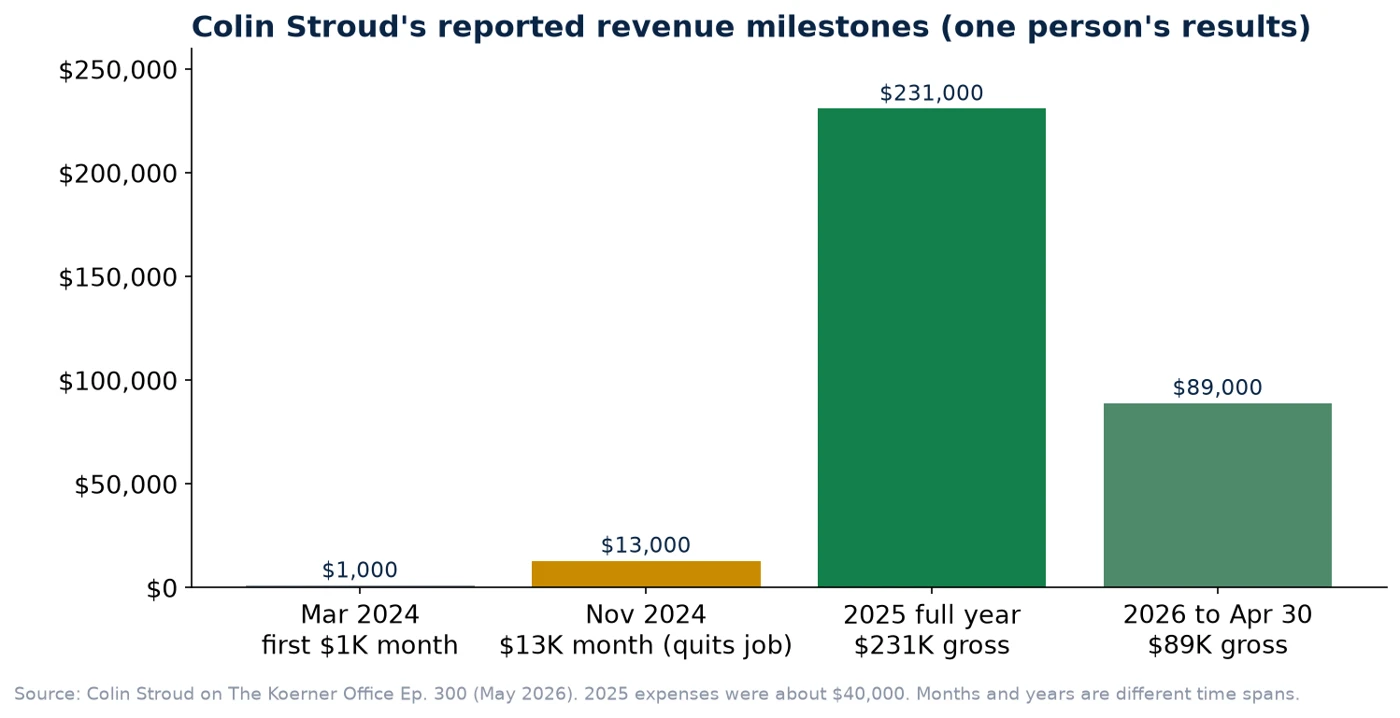
- Before launch: He was working in insurance and then nonprofit fundraising, married young with a baby. He’d only known about points for a few months.
- March 2024: first $1,000 month. Costs were about $100 in software subscriptions.
- About 15 months as a side hustle, taking calls early in the morning, on lunch breaks and late at night.
- November 2024: a $13,000 month, mostly profit. With a baby due in two weeks, he quit his job.
- 2025, first full year: $231,000 gross revenue, about $40,000 in expenses (software, some travel and contractors, the biggest line). That leaves roughly $191,000 before taxes.
- 2026 through April 30: $89,000 in revenue, on pace to pass 2025.
A quick reality check on the $231,000: if every dollar came from the $875 package, that would be about 264 consults. It didn’t. Revenue also came from the trip research service and from affiliate commissions, and his consult price was lower for part of the year. He didn’t give a split.
How much time one client takes
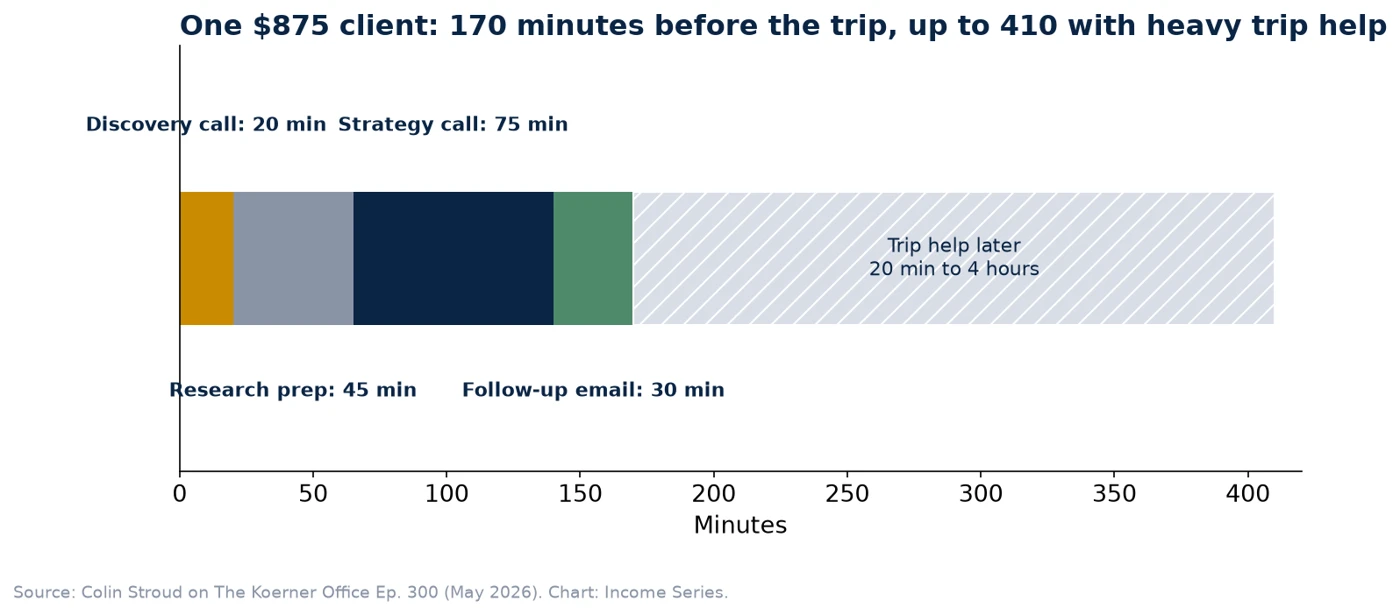
Stroud broke down a typical $875 client like this: a 20-minute discovery call, 45 minutes of research and prep, the 75-minute strategy call, and about 30 minutes writing the follow-up email, which he says “takes a lot of thought.” That’s 170 minutes, or about $309 an hour.
Then comes the trip, sometimes six months later. It might take 20 minutes. It might take four hours. In his words, “sometimes my hourly rate is amazing and sometimes it’s painfully low.”
| Scenario | Total time | Effective hourly rate on $875 |
|---|---|---|
| Client never books the trip | 2 h 50 min | about $309 |
| Quick trip (20 minutes) | 3 h 10 min | about $276 |
| Heavy trip (4 hours) | 6 h 50 min | about $128 |
Income Series calculation from Stroud’s time breakdown. Excludes time spent on marketing.
Some clients never come back for the trip at all. Stroud says many are satisfied simply knowing they’ve gone from earning 1% to 2% or 2.5%, because the feeling he hears most often is “I’m leaving money on the table.”
The daily LinkedIn grind

Every client has come from inbound interest, almost all of it from LinkedIn, plus some referrals now. He has “no experience doing outbound sales. Zero.” The routine:
- Post one to two times a day, six days a week.
- Early on, post what you learned. Before he had clients, he researched award trips for himself right up to the booking screen. One deal, a United flight to Hawaii through Turkish Airlines’ program, took about five hours and a long hold with an agent. He didn’t book it. He posted about it, and it reached almost 100,000 impressions when he had about 1,000 followers.
- Later, post client stories. Now he only posts real client results.
- Turn followers into an email list. He has about 7,000 email subscribers, nearly all from LinkedIn. He’s started posting on X too, with little traction so far.
The weak spot, which he named himself: if LinkedIn disappeared tomorrow, most of his lead flow would go with it. The email list is the hedge. If you’re working out where your first customers come from, our guide on how to find clients for your side hustle covers other channels.
Who the clients are
Not the people you’d guess. Stroud’s best clients are blue-collar business owners, many in construction: people who might spend millions a year on cards and have never left the country. A builder spending $60,000 a month on lumber earns plenty of points from one good card. Tech founders, he said, have been his least favorite clients because they feel they already know everything.
His first business-owner client was his own parents’ private medical practice. It was spending about $40,000 a month on a local bank’s 1% cash back card. He moved it to a Capital One and Chase setup across the practice’s two entities, and it earned well over a million points in year one (with help from a Chase promotion that has since ended). They used the points for a resort stay he valued at about $9,000.
How affiliate income fits in
Affiliate commissions started as an add-on and became “a key part” of his revenue. When someone signs up for a premium card through his link, the commission can be around $400. He shares links with clients, in his newsletter and on social.
If you add affiliate links, the FTC requires a clear disclosure of the relationship wherever you share them. The rule sits in the FTC’s Endorsement Guides (16 CFR 255.5), which cover material connections such as commissions.
How to start credit card rewards consulting, the way he did
- Learn for a weekend. His claim: “If you spent a weekend with some of these blogs and Claude, you would know more about credit card points than 90% of people in the world.” His recommended starting point is the Daily Drop’s free course; he also named Frequent Miler, The Points Guy and One Mile at a Time.
- Practice on trips you never book. Search award space, price the transfers, get to the payment screen, stop. He uses seats.aero daily to search many airline programs at once.
- Start with the simple win. You don’t need to be an award-booking expert on day one. Moving a business owner off a 1% card is, in his words, “not rocket science,” and he suggested a beginner could charge around $400 for it.
- Post what you learn. Daily, on the platform where business owners already are.
- Keep the offer flat-fee and simple. He charges flat prices so clients know exactly what they’re paying.
- Hire help for the repetitive work. Two contractors now handle about 90% of the trip research. He tracks about 35 active trips on a custom dashboard he built with an AI app builder.
- Set aside money for taxes from the first payment. See our side hustle taxes guide.
Doing it alongside a job? He did, for about 15 months. Our guide to balancing a side hustle with a full-time job has a schedule that fits this kind of call-based work.
Where AI fits, and where it doesn’t
Stroud is candid that AI tools are now very good at points questions, and that one day he may be no different from a chatbot. His case for a human: busy owners want to talk to a person, and AI tends to quote best-case award prices (business class to Paris for 100,000 points) that are available on one day a year. He uses AI behind the scenes and sells the human call.
FAQ
How much can you make from credit card rewards consulting?
There’s no industry survey. The one detailed public example is Colin Stroud: $231,000 gross in 2025 with about $40,000 in expenses, after starting at around $1,000 a month in early 2024. Treat that as one person’s ceiling-level result, not an average.
What do credit card rewards consultants charge?
Stroud charges $875 for a one-time business owner package and about $200 to $500 for trip research. He started at about $75 per consult.
Do you need experience to start?
He had known about points for only a few months when he began. He recommends a weekend of free blogs and courses, then practicing on trips you don’t book.
Where do clients come from?
For Stroud, almost entirely from posting on LinkedIn one to two times a day, six days a week, plus referrals. He has never done outbound sales.
How long does one client take?
About 2 hours 50 minutes for the consult work, plus anywhere from 20 minutes to 4 hours if the client books a trip later.